Connect with us

News

Israelis back war with Iran despite uncertainty and fatigue

Published

on

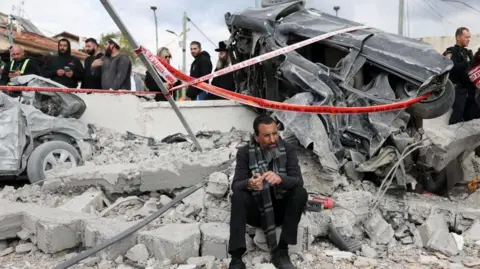
A sense of normality is slowly returning to Israel, even as large-scale Israeli-American attacks on Iran show no sign of abating, and as Israel expands its air bombardment and ground invasion of Lebanon in its offensive against the Iranian-backed militia Hezbollah.

Six days on, as the intensity of the Iranian retaliation has diminished, measures that banned gatherings and closed shops and offices are being relaxed here. Air raid alerts still sound, sending people across the country to shelters.

Chaya Dekel, who is in her 70s, said she had lost count of many wars she had seen. She was tired, she said, but defended the war as Iran “didn’t want peace”.

“We’re living here, with hope that there will be an end,” she said. “Everybody is Israel hopes we’ll live in peace with our people and our neighbours.”

Support for the war is strong in this country. A poll released by the Israel Democracy Institute on Wednesday suggested that 93% of the Jewish public were in favour of it, compared with 26% among Israeli Arabs.

“This is actually a consensus,” Prof Tamar Hermann, a senior research fellow who helped carry out the survey, said. “Even during the last campaign against Iran, we didn’t have such high numbers.”

One of the reasons behind that, she said, was the fact that the damage in Israel from Iran’s retaliatory strikes had been “very, very limited”.

This is due to Israel’s sophisticated air defences – a multi-layered system of protection that, according to officials, has intercepted between 80% to 90% of the projectiles fired at the country in this war. So far, the attacks have killed 10 people across Israel.

Another factor, Prof Hermann said, was that public trust in the military and the intelligence services has recovered after the security failures that led to the attacks on 7 October 2023 led by Hamas – one of the militant groups in the region that Iran has supported to form a so-called “ring of fire” around Israel.

But, crucially, there is also unity over the Iranian issue which, for decades, has been framed by many as an “existential threat”. That includes Prime Minister Benjamin Netanyahu.

From his 1995 book Fighting Terrorism to his famous speech at the United Nations General Assembly in 2012, when he displayed the illustration of a bomb to explain how close, in his view, Iran was to obtaining a nuclear weapon, Netanyahu has repeatedly told the world that Iran must be stopped.

Last June, Netanyahu, who is Israel’s longest-serving prime minister and the leader of the most right-wing government in the country’s history, ordered an attack on Iran that significantly damaged its nuclear and military capabilities.

The US eventually joined the conflict, which became known as the 12-Day War.

The campaign was celebrated as a success in Israel, helping boost domestic support for the army.

Earlier this year, Iran’s security forces brutally repressed anti-government protests, killing thousands of people.

The demonstrations exposed huge public discontent amid mounting questions about the legitimacy of rule by the clerics and an economy in deep crisis.

With the leadership under pressure, Iran’s defences downgraded and its proxies weakened, Israel and the US saw an opportunity to attack Iran that was not to be missed.

President Donald Trump deployed what he described as an “armada” to the Middle East – marking the largest US military build-up in the region since the American-led invasion of Iraq in 2003.

But neither him nor Netanyahu has clearly laid out what imminent threat Iran presented which required the use of military force or what their objectives were of this latest war, which Iran says is illegal and unjustified.

Israeli officials, including Netanyahu, have publicly said they hope it could lead to regime change in Iran.

For now, this is an unlikely scenario, even after the killing of the Supreme Leader, Ayatollah Ali Khamenei, in an air strike on his compound in Tehran on the first day of the war.

Khamenei had repeatedly called for the destruction of Israel, as well as urging crowds chanting “Death to America” every week.

The war, Netanyahu said earlier this week, will “usher in an era of peace that we haven’t even dreamed of”.

He also laughed at the suggestion that he had dragged the US into this conflict, describing it as “ridiculous”.

In the US, where public support for Israel has declined sharply in the wake of the war against Hamas in Gaza, just one in every four Americans support the strikes on Iran, according to a Reuters/Ipsos poll.

The perception that this is a conflict to defend Israel’s interests could damage Israel’s image in the US even further.

In Israel, however, there has been very little criticism of Netanyahu’s decision to go to war, even from his opponents.

And according to the Israel Democracy Institute poll, among Jews, 57% believe that the bombing should not stop until the current Iranian rulers are overthrown.

“[Israelis] see that the people of Iran share this goal…so they believe this is the opportunity [to do it] with the Israelis and Americans from the air, and the people of Iran on the ground,” said Prof Meir Javedanfar, an Israeli-Iranian analyst and professor at Reichman University in Herzliya.

“I don’t think they realise how difficult that is.”

At the same time, many in Israel are tired.

“It’s been five years of constant upheaval. It was the judicial reform [plans by the government to limit the powers of the Constitutional court which led to huge protests], then 7 October, then Iran a year ago. Now we have this, and we’ve had Lebanon in the middle,” Tom Dan said after leaving a bomb shelter.

“Obviously, a lot of other people are living tougher lives…but there’s this feeling that this is a good cause. This [Iranian] regime was hell bent on destroying Israel.”

But have Israelis become too happy to embrace militarism?

“I certainly would say that, on the radical right, people are much more eager to deal with the regional problems by force,” Prof Hermann said.

“They see it as something that separates Israeli Jews from diasporic Jews. For example, we’re strong. We’re capable of defending ourselves.

“And all this mumbo-jumbo of diplomatic negotiations is something that won’t save us once there is someone in Tehran that is interested in destroying us.”

Rut Spigler, a 19-year-old student on a gap year, was helping clean up the site that was hit by an Iranian missile in Tel Aviv the morning after the attack.

“The times the Israeli people most came together were the wars with Iran because that’s a goal that we believe in,” she said.

“Maybe this one will be the last war and we’ll have some peace and quiet.”

There is a small minority, though, who question the reasons for starting a new war.

Ron, who did not want to give his full name, owns a coffee shop in central Tel Aviv.

“I feel sadness, fear and frustration, and it’s a bad time for Israel. Israel should not attack Iran – it not the police of the world,” he said. “[There’s] no right under international law…you don’t have the right to attack a nation far away from here.”-STAR.

Continue Reading
Click to comment

Leave a Reply

Your email address will not be published. Required fields are marked *

News

National Assembly dismisses claims Sacco Bill is being rushed through Parliament

Published

on

The National Assembly has dismissed reports that the Sacco Societies (Amendment) Bill, 2025, is being rushed through Parliament, saying the proposed law is still undergoing public participation.

Through infographics shared on Facebook on Tuesday, July 14, 2026, Parliament said misleading information had been circulating online about the Bill, formally known as the Sacco Societies (Amendment) Bill, National Assembly Bill No. 32 of 2025.

Bill was published in June 2025

The National Assembly said the Bill was published on June 30, 2025, and had remained under consideration for more than 12 months.

It rejected suggestions that lawmakers were fast-tracking the proposed amendments without allowing enough time for scrutiny.

According to Parliament, the lengthy period between the publication of the Bill and its current consideration shows that it is not being rushed.

Bill currently before the National Assembly committee

The Sacco Societies Amendment Bill is currently before the National Assembly’s Departmental Committee on Trade, Industry and Cooperatives.

The committee is conducting public participation and receiving views from members of the public and other stakeholders.

The submissions are expected to help the committee assess the proposed amendments before presenting its recommendations to the National Assembly.

What happens after public participation?

After the public participation process is concluded, the committee will prepare a report containing its findings and recommendations.

Parliament said the views submitted by members of the public and stakeholders could inform further amendments to the Bill.

The proposed legislation will then proceed to the National Assembly for consideration by MPs.

This means the Bill has not yet completed the legislative process and could still be amended based on the submissions received during public participation.

Bill will be forwarded to Senate

The National Assembly also clarified that the Bill will not proceed directly for presidential assent after being passed by MPs.

Because the proposed legislation concerns county governments, it will be forwarded to the Senate for consideration in accordance with the Constitution.

The Senate will be required to consider the Bill before it can complete the parliamentary process and be presented for presidential assent.

Parliament urged members of the public to rely on verified information about the Sacco Societies Amendment Bill instead of unconfirmed reports circulating online-PeopleDaily.Digital.

Continue Reading

News

Digital house-hunting platform bets on technology to reshape Nairobi’s rental market

Published

on

NAIROBI, Kenya, July 14 – A growing shift towards digital property searches is changing how Kenyans find rental homes, with real estate technology platform Reemio positioning itself as a solution to longstanding challenges.

This included fraudulent listings, costly house searches and limited market transparency.

As younger, tech-savvy consumers turn to online platforms to make purchasing decisions, the company says digitizing the rental process could improve efficiency for both tenants and landlords while lowering transaction costs.

“Our niche is to solve the problem of house hunting and also bring trust into that process. We use technology to connect renters and landlords,” said Kimani.

Kimani said the platform seeks to address inefficiencies that have traditionally made house hunting expensive and time-consuming.

Instead of physically visiting multiple properties, users can browse verified listings, take virtual tours, compare amenities and access information on additional costs such as water charges, electricity bills and service fees before scheduling physical viewings.

Beyond improving convenience for tenants, Reemio argues that technology can help landlords reduce marketing costs, shorten vacancy periods and reach a wider pool of prospective tenants, including Kenyans living abroad.

The company says its platform also generates market data that can help property owners and developers better understand evolving consumer preferences, although its long-term impact will depend on wider adoption of digital property platforms and continued investment in trustworthy online real estate marketplaces-Capitalfm.co.ke.

Continue Reading

News

ORPP edges two parties closer to joining Kenya’s political arena

Published

on

The Office of the Registrar of Political Parties (ORPP) has issued a notice for the provisional registration of two proposed political parties, opening a seven-day window for members of the public to lodge objections.

In a notice published by the Registrar of Political Parties and Chief Executive Officer J.C. Lorionokou, the ORPP announced that the Social Democratic Party of Kenya (SDP) and the People’s Alternative Voice (PAV) are in the process of being provisionally registered under Section 5(2)(a) of the Political Parties Act.

The ORPP, a State office established under Section 33 of the Political Parties Act and Article 260 of the Constitution, said its mandate includes registering and regulating political parties as well as administering the Political Parties Fund.

According to the notice, the Social Democratic Party of Kenya (SDP) has adopted pink, white and sky blue as its official party colours, with the slogan “Change – Mageuzi.” The party’s symbol is the acronym SDP enclosed inside a circle.

The party’s listed founder members are Nyangong’ Duncan Nyumbah, Omwandasi Jared Dishon and Kinyua Mary Wacuka.

The founders of PAV are listed as Odenyo John Fitzgerald Elly, Nyando Rachel Mmboga and Ali Hussein Kiplangat.

The Registrar said particulars of the two proposed political parties have been published on the ORPP website to facilitate public scrutiny as required by law.

Any person wishing to oppose the provisional registration of either party has seven days from the date of publication of the notice to submit objections either in writing or in person to the Office of the Registrar of Political Parties at Lion Place, Fourth Floor, Waiyaki Way at Karuna Close, Nairobi.

The provisional registration marks the first step in the legal process of establishing a political party in Kenya.

Kenya has 91 fully registered political parties. The ORPP’s updated register indicates that, as of January 2026, there were 91 parties that had met the legal requirements for full registration under the Political Parties Act-STAR.

Continue Reading

Trending